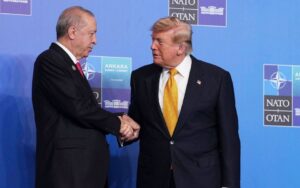
The NATO Summit in Ankara concluded Wednesday without Turkish President securing an explicit commitment from U.S. President regarding the sale of F-35 fighter jets to Turkey.
Trump said he had not yet made a final decision on this. However, he inclined to recognize Erdoğan’s cooperation with the U.S.
For Athens, Trump’s reluctance to make a definitive announcement was viewed as a temporary reprieve. The U.S. president intended to lift CAATSA sanctions against Turkey and explore ways to bypass provisions of the 2020 NDAA, which prohibits the transfer of F-35s to Turkey unless.
Kremlin says Russia is in touch with Turkey on fate of Russian S-400 missiles.
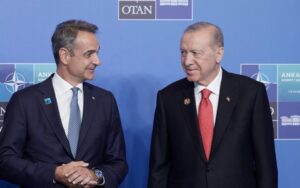
Greek Prime Minister avoided publicly urging Washington not to sell the aircraft to Turkey, saying it was not Greece’s role to dictate U.S. defense sales. Instead, he reiterated Greece’s opposition to Turkey’s longstanding casus belli declaration, describing it as a “historic anachronism” incompatible with both the Athens Declaration and efforts to build good-neighborly relations.
Mitsotakis added that European leaders increasingly recognize that maintaining a formal threat of war between NATO allies is inconsistent with the Alliance’s spirit.
Erdoğan praised Trump’s positive attitude and expressed confidence that once the F-35s are delivered, “the world will say America honored its promise.” On the Aegean dispute, he echoed Mitsotakis’ view that resolving bilateral issues is primarily the responsibility of the two countries’ leaders.
About Turkey’s casus belli policy, he declined to engage directly, arguing that Turkish citizens are unfamiliar with the issue and both governments should avoid burdening their publics with historical disputes.
NATO Secretary General Mark Rutte also refused to comment on the F-35 issue, describing it as a bilateral matter, as he similarly declined to comment on Turkey’s S-400 missile system, calling it an issue between Washington and Ankara.
Despite Trump’s public caution, diplomats in Athens believe the U.S. president remains determined to move forward with supplying F-35s to Turkey and will attempt to do so before the November U.S. midterm elections.
The key obstacle is not Trump’s intentions, but whether the current Congress can block such a move.
As a result, many believe the coming months will be critical.
Trump could seek approval of the five F-35 aircraft. That way Turkey will ultimately secure the aircraft, particularly if Ankara finds a formula to resolve the issue of S-400 missile system. Once a major defense program begins, reversing it becomes politically difficult.
Turkey’s strategic importance has increased for both the US and Europe, making it increasingly difficult for Greece to expect Washington to prioritize Greek concerns in the current geopolitical environment.
Diplomats caution, that Greece should respond strategically rather than emotionally to any developments.
Turkey’s efforts to participate in Europe’s expanding defense initiatives is an even more significant long-term challenge. With a growing bilateral defense agreements with European countries, Turkey is positioned to benefit from increased European defense spending.
The broader strategic question is whether Greece should continue offering unconditional support to the United States without seeking stronger reciprocal commitments.