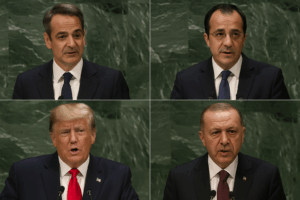

September 2025 – As world leaders gather for the 80th UN General Assembly in New York, Athens is playing a careful yet assertive game: defending sovereign rights in the eastern Mediterranean, pressing for a Cyprus settlement that preserves the Republic, and watching closely as the U.S. and Turkey maneuver around issues that directly affect Greek and Cypriot interests. Even with Turkish President Erdogan canceling a planned meeting with Prime Minister Mitsotakis, Greece signaled it would not shift course.
Energy and sovereignty: Chevron, cables and red lines
Mitsotakis emphasized that Greece will move forward with hydrocarbon exploration south of Crete, backed by Chevron’s interest, and positioned Athens as a key energy hub. Asked about Turkey’s objections, he shrugged them off with a terse “c’est la vie” — a pointed reminder that Greece will not be deterred.
Behind the scenes, Athens is using the UN week to deepen partnerships with energy firms and allies, underlining that commercial commitments and new interconnectors raise the cost of any unilateral Turkish moves.
Cyprus: engagement without legitimizing partition
Cyprus remains central. Athens welcomed UN efforts to restart talks but drew a hard line against Ankara’s push for a two-state solution. Greece insists that only a settlement preserving the sovereignty, territorial integrity, and bi-communal character of the Republic of Cyprus is viable.
Cypriot President Nikos Christodoulides echoed that message in New York, underscoring that the Republic of Cyprus is ready for a new UN-led process — but only within the framework of international law and UN resolutions. He made clear that any discussion of a “two-state” model is unacceptable and would entrench division rather than build peace.
Halki: religious freedom as diplomacy
The Halki Seminary issue resurfaced following discussions in Washington involving Patriarch Bartholomew, U.S. leaders and President Erdogan. Athens cautiously welcomed talk of reopening the seminary as a step for religious freedom, while stressing that it cannot be reduced to a bargaining chip.
F-35s and the defense dimension
Security issues were also in the spotlight. Erdogan’s meetings with President Trump and U.S. officials, touched on Ankara’s push to rejoin advanced fighter programs and potentially secure F-35 aircraft. Turkey had been removed from the F-35 program in 2019 because of its purchase of the Russian S-400 missile defense system, which Washington views as incompatible with NATO security. For Greece — already advancing its own F-35 acquisition — the prospect of Turkey’s return raises serious questions for regional balance. Athens has underscored to allies that U.S. support for NATO cohesion and Greece’s defense modernization should not come at the expense of rewarding Turkish provocations.
The U.S. angle and Athens’ bottom line
American diplomacy — from bilateral meetings to the Trump-Erdogan summit — shapes the environment in which Greece operates. Athens wants a steady framework: firm on principles like maritime law, yet open to dialogue that prevents escalation.
The message from New York was consistent: Greece and Cyprus are ready for diplomacy, but not at the expense of sovereign rights. Dialogue, yes — concessions, no.