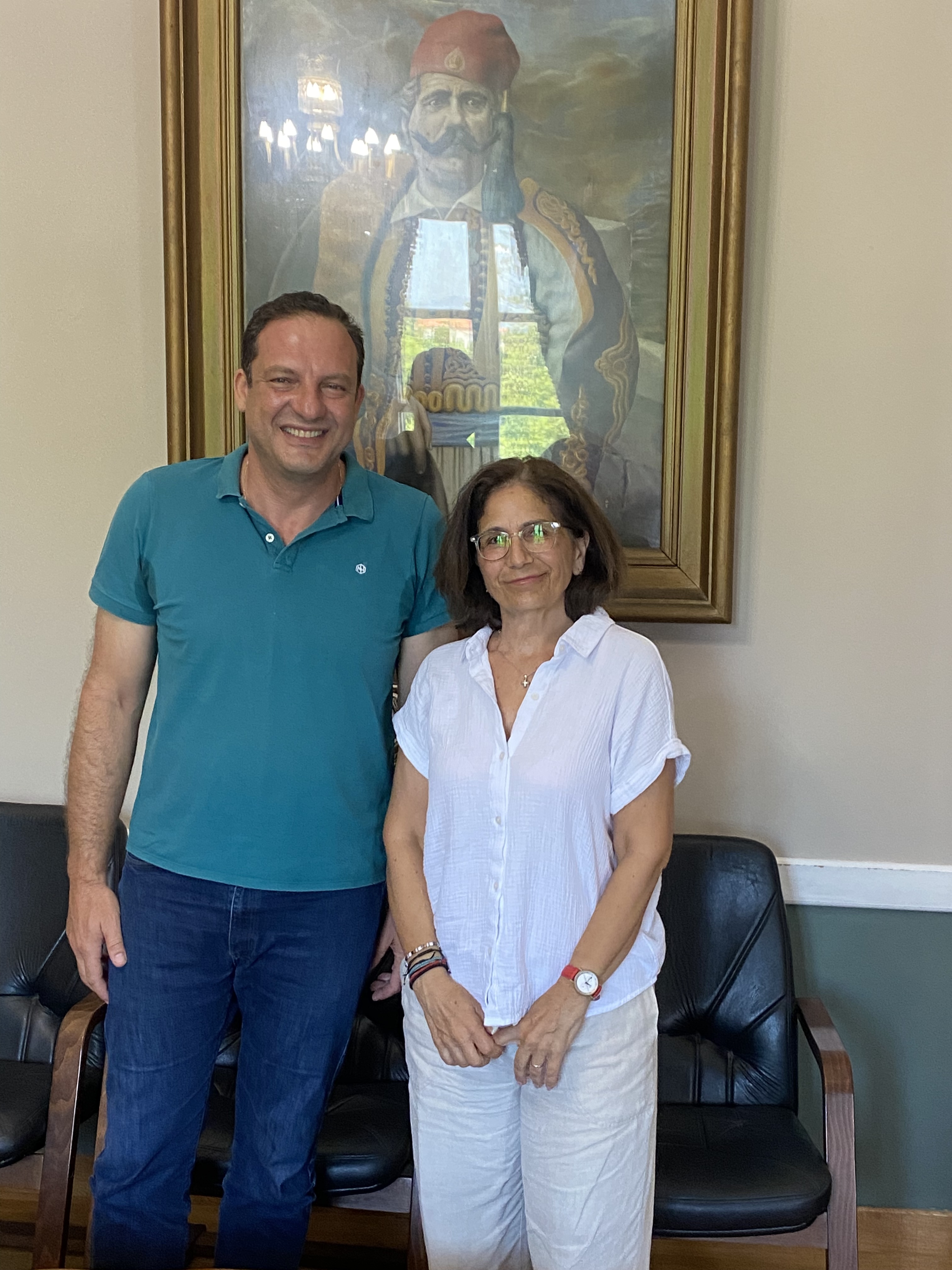
In July 2025, Dimitra Kasdagli, Executive Director of the American Hellenic Council (AHC), visited Eastern Samos to discuss with Mayor Paris Papageorgiou the island’s political and geopolitical challenges, from migration pressures to regional security at the heart of the Eastern Aegean.
Q: The American-Hellenic Council began in 1974 with the Cyprus issue, originally called the Save Cyprus Council. Over time, it has expanded its focus beyond Cyprus to broader Greek-Cypriot issues, with the main confrontation being with our neighboring country. I wanted to come here and speak with you because the Municipality of Eastern Samos is the closest point to Turkey and faces constant provocations.
Q:Generally, what is happening? Are the interventions constant and on various fronts—borders, fishing? How is this being dealt with? From what I’ve heard, we sometimes allow these things to happen because we are afraid of a real clash.
A: To summarize what you said, Dimitra, we have three main sectors.
The first is tourism, which involves the role of the National Port Fund and the situation with Turkey.
The second, which we are not directly involved in, is the purchase of real estate by Turks. As a municipality, there’s not much we can do, since they come with European passports and are legally covered. But this trend is growing, as you can see. There are different views: some say it’s a way for certain people to escape the Turkish regime and the situation there, while others believe it could evolve into an economic war. Analyses show that real estate is the second-largest economic activity on the island after tourism. Tourism here is not saturated—Samos remains an attractive destination—so people see opportunities.
The third sector is political and cultural exchanges and collaborations, to which we give special importance. We are always very careful and follow the instructions of the Ministry of Foreign Affairs.
Q: And then there’s the refugee issue and all that comes with it. How is the situation today? There is now a camp, so people are no longer living in tents on the mountainside, and they are less present in the city.
A: Migration is a difficult issue. In general, our responsibilities are limited. It is a European matter, not only a Greek one. Regarding migration, the municipality’s role is limited to collecting garbage from the camp and providing it with water. Those are our main responsibilities.
Any action at the level of cooperation or friendly initiatives is always coordinated with the Ministry of Foreign Affairs and the consulates.
Q: How active are the political and cultural exchanges and collaborations?
It is well known that our participation in certain international exhibitions is restricted as long as the Cyprus issue and the occupied territories remain unresolved. If the so-called “pseudo-state” participates, Greek delegations do not go under the Greek flag and do not participate officially. In some cases, Greece withdraws entirely. In other cases, the Ministry of Foreign Affairs files official complaints. As a municipality, we always consult the MFA before attending any trade or tourism event.
Q: Over the last two years, the European Union has granted short-term visas from Turkey for several islands, including Samos. Has this had an impact?
A: Yes. This visa program from the European Union, which allows express visits to specific islands, has brought us a tourism boom, with many visitors either coming for the day or staying a few days—visitors we would not have otherwise had. It has been a financial boost for local businesses and tourism, something positive.
Of course, it also puts pressure on the municipality, for example, on passenger terminals, which are sometimes inadequate, and on other infrastructure under municipal responsibility.
Q: And what about fishing violations? From Pythagoreio and Iraion, we can see Turkish fishing boats passing illegally through our waters, while our own fishing boats are grounded during the closed fishing season. And not just fishing boats, but trawlers that destroy the seabed.
A: This issue has been discussed at higher levels. This year, things are somewhat better thanks to more guarding. Our role is to report incidents to the relevant ministries.
These are difficult foreign policy issues—fishing zones are a constant source of conflict, and the Exclusive Economic Zone is an even bigger one.
Q: Despite these challenges, are there positive developments?
A: Yes, there are cultural opportunities. Foreigners who buy property in small villages and renovate them create jobs for locals, invite artists, and organize small music and art events—fostering cultural exchange.
This year for for the first time in Greece, Samos will host The three-day Convention of the Integrated Disaster Risk Management (IDRiM) Society with the participation of scientists from around 20 countries. One of the speakers will be the American-Hellenic Council board member Dr. Costas Synolakis.